
This guide covers the major producing countries, explains why production concentrates where it does, and shows you how to turn origin information into a sourcing decision. The trade-offs that decide most programs are fabric availability, print capability, lead time, and risk
Where Are T-Shirts Manufactured? The Global Map at a Glance
Production clusters in three broad regions: Asia, Europe, and the Americas. Asia carries the volume. According to the WTO's World Trade Statistical Review (latest edition), China ranks first in apparel exports by value, with Bangladesh, Vietnam, and India also among the largest exporters. Europe contributes high-value near-shore capacity through Turkey and Portugal. The Americas serve regional demand from the United States, Mexico, and Central America
Here is the part most guides skip. A single T-shirt is rarely made in one place. Cotton may be grown in the US or India, spun into yarn in Vietnam, knitted into fabric in China, cut and sewn in Bangladesh, then printed in the destination country to shorten replenishment cycles. When people ask where T-shirts are made, they mean the cut-and-sew stage. Everything upstream of that stage crosses several borders
That distinction has real consequences. A "Made in Vietnam" label tells you where final assembly happened. It says nothing about where the fabric came from, who controls quality, or how fast a reorder can move. Those answers come from the factory, not the flag on the label
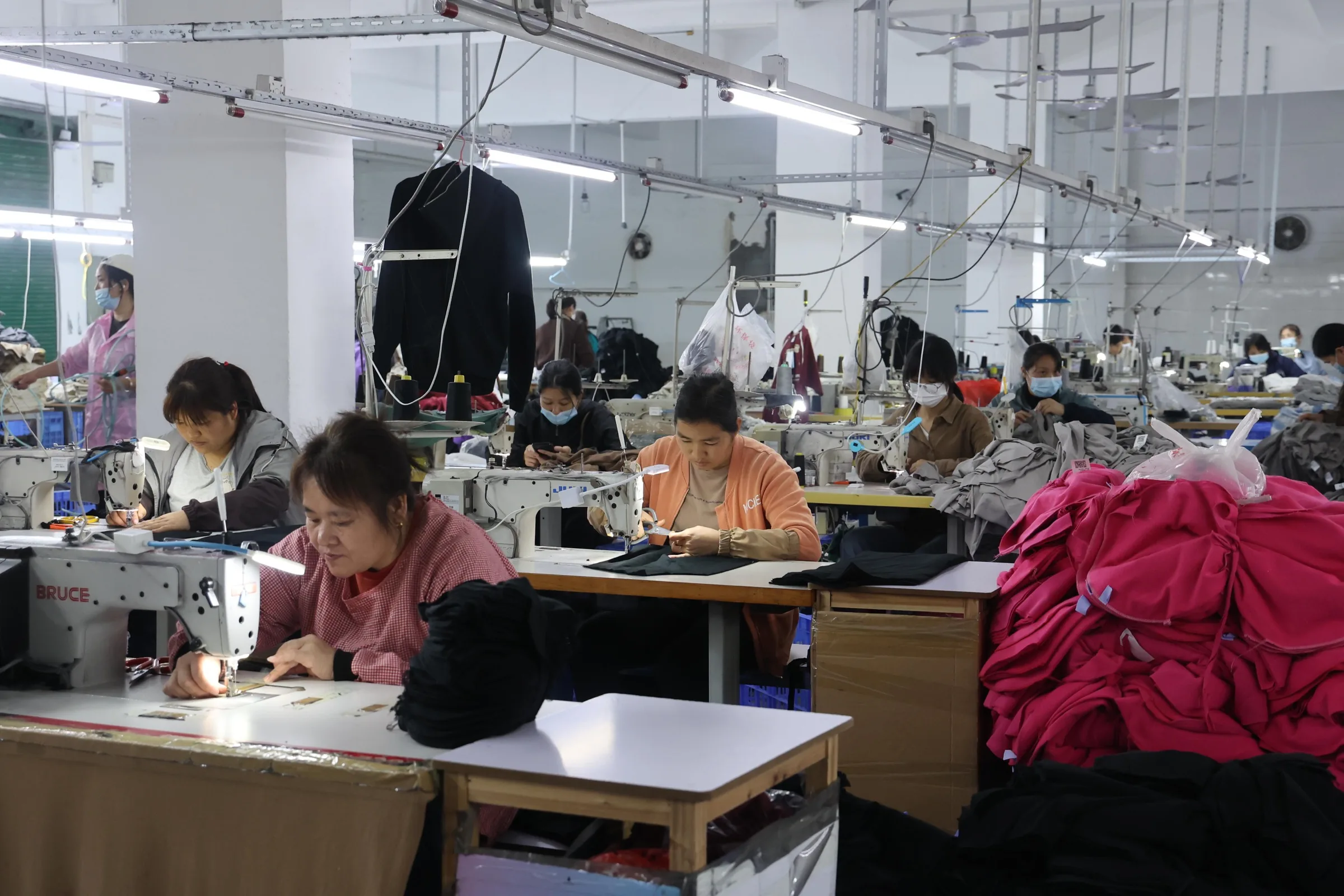
The table below is a working map, not a ranking
| Region | Main producing countries | Typical strength | Best-fit order profile |
|---|---|---|---|
| East Asia | China | Full supply chain, fabric variety, complex decoration | 500–10,000+ pcs, technical or premium builds |
| Southeast Asia | Vietnam, Cambodia | Mid-volume, competitive labor, growing capability | 1,000–5,000 pcs, basics and mid-tier |
| South Asia | Bangladesh, India, Pakistan | High-volume knits, strong cotton base | 3,000–50,000+ pcs, cost-driven basics |
| Near-shore Europe | Turkey, Portugal | Fast replenishment, EU market access | 300–3,000 pcs, premium and small-batch |
| Americas | USA, Mexico, Honduras | Speed to US market, "Made in USA" positioning | 100–5,000 pcs, domestic-label programs |
A note on ranges: these volumes reflect common practice in each region, not fixed minimums. Actual MOQ shifts with the factory, the fabric, and the decoration method. Confirm with a specific supplier before you build a plan around any number here
The Top T-Shirt Manufacturing Countries and What Each Does Best
China: The Full-Supply-Chain Hub
China has the deepest vertical integration in T-shirt production among major exporters. Inside a few hundred kilometers you can line up greige fabric, dyeing, cut-and-sew, screen printing, embroidery, and packaging. That density explains the range: 240 GSM oversized tees, garment-dyed vintage washes, moisture-wicking performance knits, multi-panel constructions with piping and contrast binding
For buyers, the payoff is optionality. Need a 320 GSM French terry crewneck tee, an enzyme wash, or puff print layered over discharge? China usually has it in-house or one district away. The trade-off shows up on plain goods: for a 30,000-piece run of 180 GSM cotton crews, South Asia will beat Chinese FOB pricing
Vietnam: The Diversification Default
Vietnam has become the first alternative most brands test when they move volume out of China. Trade agreements pulled investment in, and the sector has held quality steady in both knits and wovens. T-shirt work here skews mid-volume: solid basics, 160–200 GSM combed cotton, clean two-to-four-color screen printing
Reliability is the selling point. Factory organization is generally tight and QC systems have matured alongside the export base. Specialty fabric is a weak spot, since much of it arrives imported, which adds two to three weeks and cost
Bangladesh: Volume Economics
Bangladesh is a scale play. Cotton knits are the core competency, and T-shirts sit at the center of that. If you need 20,000 pieces of a 180 GSM single jersey tee at the lowest workable FOB, this is the obvious answer
Flexibility is where it gives ground. Short runs get deprioritized, complex decoration often goes outside the factory, and lead times stretch during the pre-holiday crush from roughly August through October. Bangladesh works on a 12–16 week planning horizon; below that, capacity allocation goes to larger accounts
India: Cotton Depth and Finishing Craft
India pairs domestic cotton supply with a textile base that goes back generations. The range runs from commodity knits to GOTS-certified organic cotton, slub yarns, and hand-finished detail. Brands building around natural fibers, certification claims, or smaller premium batches find options here that Vietnam and Bangladesh cannot match
Export logistics are the variable. Port handling and inland transport swing more than in China or Vietnam, so build a two-week buffer into any Indian schedule
Turkey and Portugal: Europe's Near-Shore Pair
Both serve EU brands on a compressed clock. Turkey is strong in cotton knits and can turn a repeat order in three to five weeks with truck freight into Western Europe in under a week. Portugal specializes in premium construction, garment dyeing, and runs of 300 to 1,000 pieces that Asian factories decline
The math for an EU brand is straightforward: a higher unit price buys back several weeks of calendar, which matters most for drop-driven businesses and mid-season restocks
USA and Mexico: Speed and Labeling
US production exists to support "Made in USA" positioning and short runs at premium retail. Mexico and Central America sit in between, offering competitive labor for mid-volume programs with two to seven days of transit into US warehouses instead of a month at sea
This region fits programs where speed to shelf or a domestic label earns back the unit-cost gap; on pure scale economics, Asian FOB pricing still wins
Comparison Table: Country vs. Best-Fit Order Type
| Country | Best-fit order type | Typical lead time (production + shipping) | Main trade-off |
|---|---|---|---|
| China | Technical, premium, complex decoration | 30–45 days production + 20–35 days sea freight | Higher unit cost on plain basics |
| Vietnam | Mid-volume basics and mid-tier | 30–45 days + 25–35 days | Specialty fabric often imported |
| Bangladesh | High-volume cotton basics | 45–60 days + 25–35 days | Lower flexibility, peak-season delays |
| India | Organic and specialty cotton | 40–60 days + 25–35 days | Variable logistics |
| Turkey | Fast replenishment for EU | 20–35 days + 5–10 days | Higher unit cost |
| Portugal | Premium small-batch | 25–40 days + 5–10 days | Highest unit cost |
| USA / Mexico | Speed, domestic labeling | 15–30 days + 2–7 days | Limited scale, higher cost |
These are common ranges for standard cotton tees. Fabric, decoration, season, and order size all move them. Confirm current timelines with your supplier before you commit to a launch date
Why T-Shirts Are Made Where They Are: Cost, Cotton, Capability
Three forces set the map
Labor cost Cut-and-sew resists automation, so assembly migrates toward lower wage structures. That single factor built the Bangladeshi and Vietnamese garment sectors
Raw material access India and China grow cotton and spin yarn at home. Bangladesh imports most of its fabric, which is why its cost edge lives in assembly rather than materials, and why fabric lead time is its recurring bottleneck
Supply chain maturity Efficient production needs mills, dye houses, trim suppliers, accessory makers, and freight infrastructure within reach of each other. China's density across those supporting industries is exactly why it absorbs the builds that require five specialized vendors to cooperate on one style
How Country of Origin Affects Fabric, Quality, Lead Time and Risk
Origin shapes four things you will feel directly in your order
Fabric availability China and India offer the widest menus, from 120 GSM lightweight jersey through 300 GSM fleece-backed heavyweight. Vietnam and Bangladesh concentrate in the 160–220 GSM standard band. When a design depends on a specific hand-feel or finish, fabric access often decides your country before price gets a vote
Quality consistency Mature export sectors in China, Vietnam, and Portugal run standardized QC with documented AQL sampling. Newer clusters can produce strong work, but lot-to-lot variance widens. Ask any factory how in-line inspection is staffed and what the final audit report actually contains
Lead time Near-shore production in Turkey, Portugal, or Mexico removes three to five weeks of ocean freight, which is often worth a higher FOB for brands on a fixed drop calendar
Risk Long chains carry more exposure to port congestion, currency movement, tariff changes, and peak-season capacity reallocation; splitting volume across two regions hedges that at the cost of duplicated QC and two fit standards to reconcile
For how fabric choice interacts with origin, see our guide to fabric options for t-shirts
Unsure which origin fits your design? Talk to our team and we will map your brief to a production setup
How to Tell If a Manufacturing Location (and Factory) Is Right for You
Origin is a filter, not a decision. The factory behind the label determines whether your order ships on time and to spec
Direct Factory vs. Trading Company
A trading company sources on your behalf, usually across several factories. That helps when you need a broad product range and one point of contact. What you give up is visibility: you may never learn which factory ran your order, and QC sits one layer away from you
A direct factory owns its production lines. You see the floor, the QC process, and the people accountable when a measurement drifts. For brands building a recurring product line, a custom t-shirt manufacturer with in-house capability delivers better consistency and solves problems faster
Match the model to the order. One-off promotional runs work fine through a trading partner. Recurring private-label programs belong with a direct factory
First-Time Buyer Checklist: 8 Things to Verify Before You Order
- Production model — Factory or middleman? Ask for a live video walkthrough of the floor
- Sampling capability — Can they build a pre-production sample in your actual fabric with your actual decoration?
- Fabric sourcing — Do they stock your target GSM and blend, or import it?
- Decoration range — Screen print, heat transfer, embroidery, sublimation: which run in-house?
- QC process — What checkpoints exist, and do you receive the inspection reports?
- Communication — Who is your named contact, and what response time do they commit to?
- Reorder capacity — Can they repeat the order without re-tooling or re-sampling?
- References — Ask for comparable programs they have already run
A supplier who answers all eight without hedging has earned a sample order. One who dodges on production model or QC is a risk no country of origin will offset
Inside a Modern T-Shirt Factory: From Sampling to Shipping
Here is how a custom T-shirt program runs at YAUUM, brief to delivery
Sampling, Fabric, Cutting, Sewing, Printing and QC
Sampling Work starts from your tech pack or reference garment. A pre-production sample locks fit, fabric hand-feel, and decoration placement before bulk cutting begins. Large or multi-color prints get a strike-off first so color lands where you expect. Our t-shirt sampling process walks through each stage
Fabric sourcing Fabric is matched to your GSM, blend, and finish spec, then tested for shrinkage and color fastness before anything reaches the cutting table
Cutting Patterns are graded across the size run and fabric is cut in layered stacks. Cutting accuracy is what keeps fit consistent from the first piece to the last
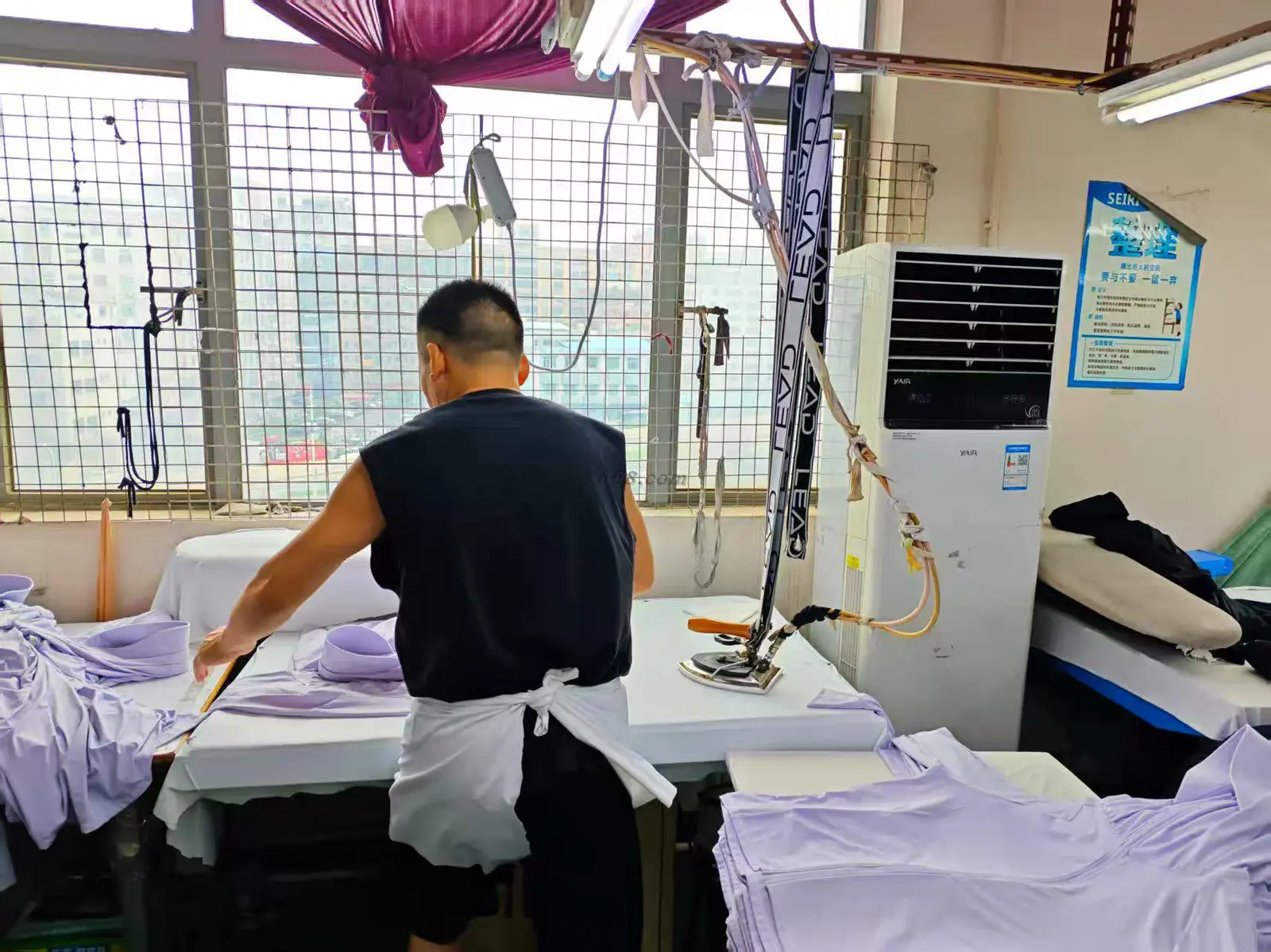
Sewing Assembly runs on dedicated lines with in-line checks that catch stitch defects and measurement drift before garments reach finishing
Printing and finishing Screen printing, heat transfer, embroidery, and specialty washes are applied to spec. Our custom t-shirt printing services cover flat and dimensional decoration
Quality Control Checkpoints at Every Stage
QC is not one inspection at the end. Fabric is inspected on receipt, garments are checked in-line during sewing, and a final audit covers measurements, stitching, decoration placement, and labeling before packing. Nothing that fails the audit goes into a carton
Want to see how this works for your design? Contact us to discuss your sampling plan
Why Brands Choose YAUUM as Their T-Shirt Manufacturing Partner
YAUUM is a B2B apparel manufacturer working across six categories: hoodies, T-shirts, jackets, pants, sportswear, and streetwear. On T-shirt programs we handle fabric sourcing, cut-and-sew, decoration, and QC under one roof
What that gives you:
- Direct factory relationship You work with the team running your order, not an intermediary passing messages
- Full decoration range Screen print, heat transfer, sublimation, embroidery, chenille, applique, and garment wash
- Category depth The same floor produces hoodies, sweatpants, and jackets, so a full drop ships together on one booking
- Reorder readiness Patterns and specs stay on file, so repeats skip setup and go straight to cutting
Typical starting quantity is 500 pcs per style per colorway; sampling runs 7–12 days after tech pack confirmation, and quotations come back within 24 business hours
Brands at every stage work with us, from a first 500-piece collection to established private-label programs spanning several categories
Frequently Asked Questions About T-Shirt Manufacturing
Where are most T-shirts manufactured?
Most T-shirts are manufactured in Asia, led by China, Bangladesh, Vietnam, and India. China handles the widest range of builds, Bangladesh and Vietnam dominate high-volume cotton knits, and India is strong in organic and specialty cotton. Turkey and Portugal serve European demand, while the US and Mexico supply the Americas
Are T-shirts still made in China?
Yes. China remains the largest apparel exporter by value and the most vertically integrated T-shirt manufacturing country. It is particularly strong for complex decoration, specialty fabrics, and premium builds. For plain cotton basics at very high volume, other regions may offer lower unit costs
What country makes the best quality T-shirts?
Quality depends on the factory, not the country. China, Vietnam, and Portugal have mature export sectors with standardized QC, but strong and weak factories exist everywhere. The better question is whether a specific factory can meet your fabric, construction, and decoration spec consistently
Why are so many T-shirts made in Bangladesh?
Bangladesh built a large cotton knit industry around competitive labor and export scale. It is one of the world's largest apparel exporters, making it a natural fit for high-volume basic tees. The trade-off is lower flexibility for small runs and complex decoration
Can I get T-shirts made in the USA?
Yes, though US production typically suits smaller runs and premium or "Made in USA" positioning. Unit costs are higher than Asia, but lead times are shorter and domestic labeling can support higher retail pricing. Mexico and Central America offer a middle option for US-bound programs
How do I choose the right country to manufacture my T-shirts?
Start with your order profile. High-volume basics point to Bangladesh or Vietnam. Technical builds and complex decoration favor China. Fast replenishment for Europe favors Turkey or Portugal. Premium small batches suit Portugal or India. Then verify the specific factory, since capability varies more within a country than between countries
What's the difference between a T-shirt factory and a trading company?
A factory controls its own production lines, giving you direct visibility into QC and capacity. A trading company sources from multiple factories, which can broaden product range but adds a layer between you and production. Recurring private-label programs usually benefit from a direct factory relationship
How long does it take to manufacture custom T-shirts?
For standard cotton tees, production commonly runs 30–45 days after sample approval, plus 20–35 days for sea freight from Asia. Near-shore production in Turkey, Portugal, or Mexico can cut total lead time to 3–5 weeks. Timelines vary by fabric, decoration, season, and order size, so confirm current schedules with your supplier
Ready to Start Your T-Shirt Production? Let's Talk
Origin tells you where T-shirts can be made. It tells you nothing about who will make yours well. The gap between a smooth program and an expensive one comes down to the factory, not the flag
Send us your design brief, target quantity, and timeline. We will recommend the fabric, decoration method, and production plan, then quote a clear FOB price. Want to judge the quality yourself first? Request a t-shirt sample and we will walk you through the build step by step